TM3 Reliable Study Guide | New TM3 Study Guide
Wiki Article
2026 Latest Pass4guide TM3 copyright and TM3 copyright Free Share: https://drive.google.com/open?id=1dUJMqg8J5yyH4jQXNioHujFzuNzc31Xn
It is known to us that getting the TM3 certification is not easy for a lot of people, but we are glad to tell you good news. The study materials from our company can help you get the TM3 certification in a short time. Now we are willing to introduce our TM3 practice questions to you in detail, we hope that you can spare your valuable time to have a look to our TM3 Exam questoins. Please believe that we will not let you down. You can just free download the demo of our TM3 training guide on the web to know the excellent quality.
The ISTQB Certified Tester Advanced Level - Test Management v3.0 (TM3) certification exam is one of the top-rated career advancement certification exams. The ISTQB Certified Tester Advanced Level - Test Management v3.0 (TM3) certification exam can play a significant role in career success. With the ISTQB Certified Tester Advanced Level - Test Management v3.0 (TM3) certification you can gain several benefits such as validation of skills, career advancement, competitive advantage, continuing education, and global recognition of your skills and knowledge. The ISTQB Certified Tester Advanced Level - Test Management v3.0 (TM3) certification is a valuable credential that assists you to enhance your existing skills and experience.
>> TM3 Reliable Study Guide <<
Pass Guaranteed Quiz TM3 - ISTQB Certified Tester Advanced Level - Test Management v3.0 Unparalleled Reliable Study Guide
You can now get BCS TM3 exam certification our Pass4guide have the full version of BCS TM3 exam. You do not need to look around for the latest BCS TM3 training materials, because you have to find the best BCS TM3 Training Materials. Rest assured that our questions and answers, you will be completely ready for the BCS TM3 certification exam.
BCS TM3 Exam Syllabus Topics:
| Topic | Details |
|---|---|
| Topic 1 |
|
| Topic 2 |
|
| Topic 3 |
|
BCS ISTQB Certified Tester Advanced Level - Test Management v3.0 Sample Questions (Q17-Q22):
NEW QUESTION # 17
Assume that you are using traceability to manage test case coverage against test conditions. During test analysis, three test conditions were identified. Test design for system testing has been completed and 10 test cases (TC1 to TC10) have been designed, as described by the following traceability matrix ("C" indicates a critical test case, while "NC" indicates a non-critical test case):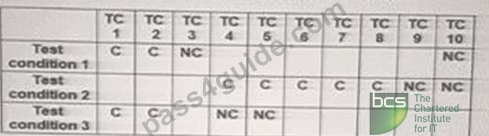
[traceability matrix not visible in the prompt]
The exit criterion for system testing states that each test condition must have all the associated critical test cases successfully executed (passed) AND all associated non-critical test cases at least executed.
The following is the situation after three days of system testing:
TC1, TC2, TC4, TC5, TC7, TC9: passed
TC3, TC10: failed (with an associated open defect report)
TC6, TC8: not run
Management wants to decide whether to release the system. You advise them that the system does not yet meet the defined exit criteria.
Based only on the given information, which test condition does not yet meet the stated exit criterion?
- A. None, all meet the stated exit criteria
- B. Test condition 1
- C. Test condition 3
- D. Test condition 2
Answer: D
Explanation:
The syllabus explicitly states thatexit criteriamust be met before considering completion of a test level:
"Exit criteria are the conditions that must be achieved to declare completion of a given test level... including coverage criteria and status of required tests (e.g., passed)."
- ISTQB CTAL-TM v3.0 Syllabus, Chapter 5Test Monitoring and Test Control And test control must act when exit criteria are not met:
"If the exit criteria are not satisfied, appropriate actions must be taken to address the situation."
- ISTQB CTAL-TM v3.0 Syllabus, Chapter 5
Sincetest condition 2 still has critical tests not yet executed, thedefined exit criteria are not fulfilled, and therefore a release decision should not be approved.
NEW QUESTION # 18
You are working as a test manager at a company that develops software applications for the mobile domain.
The organisation has recently been assessed against TMMi. This assessment showed that the company is a TMMi level 1 organisation. The projects use the V-model lifecycle and an independent test team exists. The test team consists of both experienced and novice testers. The team has not yet been formally trained in testing, but an ISTQB Foundation course is scheduled to take place in two months.
In your role as a test manager working in the independent test team, you have recently performed a risk assessment for a mobile software application to be developed. You want the features that have been identified as major risks to be tested more thoroughly.
Which test practice would you propose to mitigate the identified major product risks?
- A. Start a test improvement project to achieve TMMi level 2
- B. Assign the most experienced testers to test the features with the highest risk levels
- C. Use test design techniques such as equivalence partitioning and decision table testing
- D. Create pairs of developers and testers to test the features with the highest risk levels together
Answer: B
Explanation:
Comprehensive and Detailed Explanation From Exact Extract of ISTQB Certified Tester Advanced Level - Test Manager v3.0 syllabus:
The syllabus advises thatrisk mitigationincludes allocatingstronger capability and more efforttohigh-riskareas (e.g., by assigningmore experienced testersand more intensive testing to those features). In alow-maturity (TMMi level 1)context withnovice testers not yet trained, immediately deployingexperienced testersto high- risk items is the most practical and effective step to achievedeeper, more reliable testing.
Option B would be beneficial, but without formal training yet, immediate effectiveness is uncertain.
Option C is a longer-term improvement initiative, not a direct immediate mitigation for the current project risks.
Reference: ISTQB CTAL-TM v3.0 Syllabus, Chapter 4 (Risk-Based Testing) onallocating test effort and expertise according to product risk; Chapter 3 (Test Planning) onresourcing high-risk areasfirst.
NEW QUESTION # 19
You are a test manager in charge of integration, system, and acceptance testing for a bank. You are working on a project to upgrade an existing ATM to allow customers to obtain cash advances from supported credit cards. The system should allow cash advances from €20 to €500 (both inclusive) for all supported credit cards. The supported credit cards are American Express, copyright, Eurocard, and Mastercard. The system should be easy to use for all users, including new users.
In the master test plan, the following items are listed in the section named "items and/or features to be tested":
I. All supported credit cards
II. Language localisation
III. Valid and invalid advances
IV. Usability
Assume that the project has now been completed, and the ATM system has been in use for just over two months. You are planning a retrospective meeting for the testing work performed.
Which of the following areas is most likely to be considered in this retrospective?
- A. Operational defects occurred during the first two months of production
- B. Documenting the final and open defect list
- C. Comparing actual tests completed versus estimated number of tests
- D. The requirements engineering process
Answer: A
Explanation:
Comprehensive and Detailed Explanation From Exact Extract of ISTQB Certified Tester Advanced Level - Test Manager v3.0 syllabus:
In theTesting Process(Test Completion and improvement), the syllabus directs the test manager to useproduction and operational feedback(includingdefects found in live operation) as key inputs tolessons learnedandtest process improvement. A retrospective held after two months in production wouldspecifically examine operational defect datato evaluate test effectiveness, coverage, and the adequacy of acceptance criteria and non-functional aspects (e.g., usability, localization).
OptionB(final/open defect list) is part oftest completiondeliverables at project close, not the primary new focus of apost-deployment retrospective.
OptionC(requirements engineering process) may be discussed, but themost directly relevant and new evidencefor improvement after release isoperational defects.
OptionD(planned vs. executed tests) is amonitoring/controlactivity during the project; it can inform improvement, butlive defect trendsare the principal post-release focus.Relevant syllabus areas:Testing Process-Test Completion(lessons learned; inputs from production and operations to improve future test planning and approach).
NEW QUESTION # 20
The stakeholders matrix is a strategic tool to be used by test managers and is composed of four quadrants.
Which quadrant is described by the following statements?
Typically do not have a strong interest in day-to-day tasks
Their decisions are critical for resource allocation and high-level project direction
- A. Latents
- B. Promoters
- C. Apathetics
- D. Defenders
Answer: A
Explanation:
Comprehensive and Detailed Explanation From Exact Extract of ISTQB Certified Tester Advanced Level - Test Manager v3.0 syllabus:
In the stakeholder power-interest matrix used by test managers, stakeholders withhigh power but low interestare categorized asLatents. They generally "do not have a strong interest in day-to-day tasks," yet theirdecisions are critical for resources and strategic direction. Promoters are high power/high interest; Defenders are low power/high interest; Apathetics are low power/low interest. This mapping guides how test managers engage and communicate with each stakeholder group (CTAL-TM v3.0 Syllabus, chapter on organizational aspects of test management and stakeholder engagement).
NEW QUESTION # 21
You are a test consultant involved in setting up and implementing retrospectives in an organisation that is developing software based on an Agile lifecycle. The Agile teams are experiencing problems on product quality, so the retrospectives will be specifically focused on the testing practices and processes.
Which of the following is an example of a good practice for a test retrospective?
- A. Brainstorming sessions can be used to generate ideas on how to resolve the root causes of testing issues identified
- B. An action plan for the improvements identified is too much documentation in an Agile context; the team members are already motivated to implement the improvements based on the retrospective
- C. Only testers should be involved in the retrospectives since they perform testing and will know what should be improved
- D. Because an Agile team is empowered, all improvement actions should reside within the team
Answer: A
Explanation:
Comprehensive and Detailed Explanation From Exact Extract of ISTQB Certified Tester Advanced Level - Test Manager v3.0 syllabus:
The syllabus highlightscontinuous improvementpractices, includingretrospectivesin Agile lifecycles, encouragingcollaborative techniquessuch asbrainstormingto generateconcrete improvement ideas, often followingroot cause analysisof issues.
Effective retrospectives should involve thewhole team and relevant stakeholders, generatespecific actions (anaction plan), and recognize that some actions may requiresupport beyond the team.
Therefore,Cis a good practice.Ais incorrect (retrospectives should be cross-functional),Bis too narrow (some actions require organizational support), andDis incorrect (capturing concrete actions is recommended even in Agile contexts).
(References: CTAL-TM v3.0 Syllabus - Chapter 1 "Testing Process" - lessons learned and process improvement; Agile lifecycle considerations for retrospectives and collaborative improvement techniques; emphasis on actionable outcomes.)
NEW QUESTION # 22
......
The meaning of qualifying examinations is, in some ways, to prove the candidate's ability to obtain TM3 qualifications that show your ability in various fields of expertise. If you choose our TM3 learning guide materials, you can create more unlimited value in the limited study time, learn more knowledge, and take the exam that you can take. Through qualifying TM3 examinations, this is our TM3 real questions and the common goal of every user, we are trustworthy helpers, so please don't miss such a good opportunity.
New TM3 Study Guide: https://www.pass4guide.com/TM3-exam-guide-torrent.html
- ISTQB Certified Tester Advanced Level - Test Management v3.0 training torrent - TM3 latest dumps - ISTQB Certified Tester Advanced Level - Test Management v3.0 study material ???? Search for ➽ TM3 ???? on ▛ www.examcollectionpass.com ▟ immediately to obtain a free download ????TM3 Latest Exam Tips
- TM3 Exam ???? TM3 Valid Test Topics ???? TM3 Valid Guide Files ???? 《 www.pdfvce.com 》 is best website to obtain ▷ TM3 ◁ for free download ????TM3 Exam
- Reliable TM3 Test copyright ???? TM3 Valid Guide Files ???? TM3 Latest Exam Tips ???? Go to website 《 www.prepawaypdf.com 》 open and search for ➤ TM3 ⮘ to download for free ????Latest TM3 Mock Test
- Sure TM3 Pass ???? TM3 Exam ✌ TM3 Standard Answers ???? Simply search for ➤ TM3 ⮘ for free download on “ www.pdfvce.com ” ????TM3 Standard Answers
- Perfect TM3 Reliable Study Guide Covers the Entire Syllabus of TM3 ???? Open ➡ www.torrentvce.com ️⬅️ and search for ➽ TM3 ???? to download exam materials for free ????TM3 Latest Exam Tips
- TM3 Valid Test Topics ???? TM3 Latest copyright Ppt ???? Reliable TM3 Test copyright ???? Open website ⮆ www.pdfvce.com ⮄ and search for ▶ TM3 ◀ for free download ????TM3 Exam Fee
- BCS TM3 Exam | TM3 Reliable Study Guide - Offer you Valid New TM3 Study Guide ???? Download ⏩ TM3 ⏪ for free by simply searching on ( www.easy4engine.com ) ????TM3 Valid Guide Files
- Free PDF BCS - Marvelous TM3 - ISTQB Certified Tester Advanced Level - Test Management v3.0 Reliable Study Guide ???? Open ⮆ www.pdfvce.com ⮄ enter “ TM3 ” and obtain a free download ????Latest TM3 Exam Labs
- Prepare Well With The Best BCS TM3 Questions ➡ Easily obtain ⏩ TM3 ⏪ for free download through ⏩ www.prepawaypdf.com ⏪ ????TM3 Standard Answers
- Prepare Well With The Best BCS TM3 Questions ⏪ Download ⏩ TM3 ⏪ for free by simply searching on 【 www.pdfvce.com 】 ????TM3 Valid Test Topics
- Prepare Well With The Best BCS TM3 Questions ???? The page for free download of ⮆ TM3 ⮄ on ▶ www.prep4sures.top ◀ will open immediately ????TM3 Valid Test Topics
- shaunauvfn462826.newsbloger.com, saulskmx113734.livebloggs.com, hindibookmark.com, emilyyytd994950.blog-ezine.com, www.stes.tyc.edu.tw, checkbookmarks.com, formationenlignemaroc.com, throbsocial.com, nicoleiylo359174.nizarblog.com, hotbookmarkings.com, Disposable vapes
BONUS!!! Download part of Pass4guide TM3 dumps for free: https://drive.google.com/open?id=1dUJMqg8J5yyH4jQXNioHujFzuNzc31Xn
Report this wiki page